

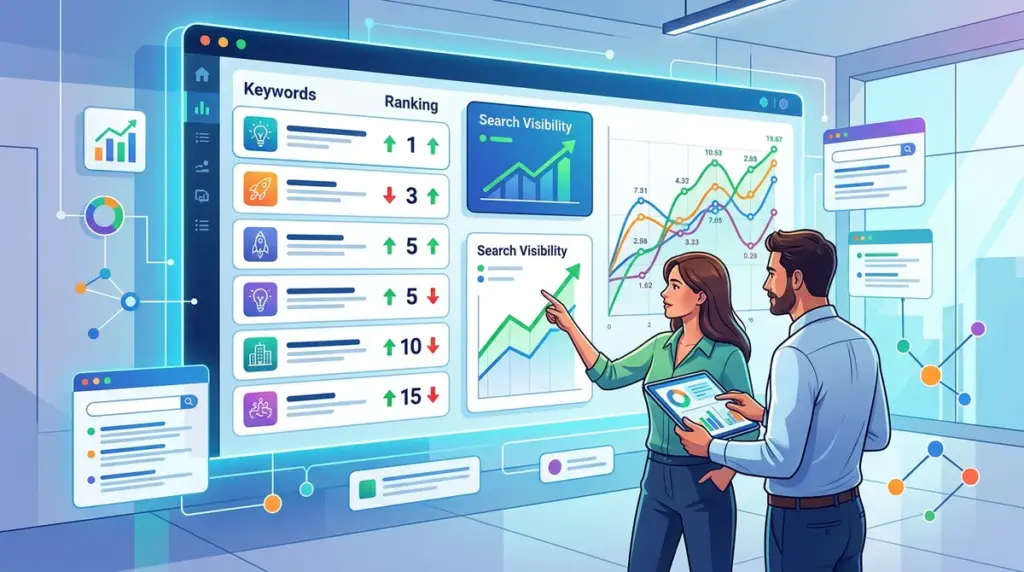
SEO investment is often treated as a black box, but keyword position tracking is the mechanism that makes the results visible. At its core, position tracking is the process of monitoring the organic ranking of specific search queries on search engine results pages (SERPs) over a defined period. For a business, these rankings are not just vanity metrics; they are the primary drivers of organic traffic, lead generation, and customer acquisition costs. Without precise tracking, a marketing team cannot distinguish between a successful content strategy and a lucky seasonal trend.
The Mechanics of Rank Monitoring
Keyword position tracking involves automated scripts or software that query search engines for specific terms from specified locations and devices. Because search results are now hyper-localized and personalized, a generic search from a data center does not reflect what a potential customer sees. Effective tracking must account for these variables to provide a "clean" data set.
Device-Specific Data Segmentation
Desktop and mobile SERPs are no longer identical. Google’s mobile-first indexing means that a site might rank in position three on a desktop but drop to position eight on a mobile device due to slow load times or intrusive interstitials. Tracking both allows agencies to identify technical SEO issues that are device-specific, ensuring that the mobile experience—which accounts for over 50% of global web traffic—is optimized for conversion.
Geographic Precision and Local SEO
For service-based businesses or brick-and-mortar retailers, ranking "nationally" is often less important than ranking in a specific zip code. Position tracking tools allow users to set specific coordinates or city-level parameters. This granularity is essential for managing "near me" queries and monitoring the Local Pack, where the top three map results capture the vast majority of local intent clicks.
Why Position Tracking Is a Commercial Necessity
The primary reason to track keyword positions is to protect and grow revenue. Organic search is often the highest-ROI channel for a business, but it is also the most volatile. Competitors are constantly optimizing, and search engine algorithms shift daily. Tracking provides the early warning system needed to react before a dip in rankings turns into a dip in quarterly earnings.
Quantifying the Impact of Algorithm Updates
Search engines frequently roll out core updates that can reshuffle rankings overnight. By tracking a broad portfolio of keywords, an SEO professional can see if a drop is site-wide (indicating a potential penalty or technical issue) or isolated to specific clusters of content. This data allows for surgical fixes rather than broad, expensive overhauls that might not address the actual problem.
Identifying "Striking Distance" Opportunities
One of the most practical uses of position tracking is identifying keywords in positions 4 through 10. These are "striking distance" keywords. Moving a keyword from the bottom of page one to the top three can result in a 200% to 300% increase in click-through rate (CTR). Tracking reveals exactly which pages are on the cusp of high-volume traffic, allowing teams to prioritize internal linking and backround building for those specific URLs.
Pro Tip: Do not rely on "Average Position" metrics in isolation. A site can have an average position of 10 because it has one keyword at rank 1 and another at rank 19. Always look at the distribution of rankings across the top 3, top 10, and top 20 to understand the true health of your organic visibility.
Measuring Share of Voice and Competitor Movement
Position tracking isn't just about your own site; it is about the landscape. Monitoring competitor rankings allows you to see when a rival brand is gaining ground on your high-value terms. If a competitor moves from position 15 to position 4 in a month, they are likely executing a specific content or backlink campaign. Position tracking gives you the intelligence to analyze their strategy and counter it.
- SERP Feature Tracking: Monitor who owns the Featured Snippet, People Also Ask boxes, and Image Packs. These features often sit above the traditional blue links and "steal" clicks even from the #1 organic result.
- Volatility Alerts: Set up notifications for when a "money" keyword drops more than three spots, allowing for immediate investigation.
- Cannibalization Detection: If two of your pages are constantly swapping places for the same keyword, tracking will highlight this "flicker," signaling that you need to merge the content or clarify the intent of each page.
The Relationship Between Rank and Revenue
While a high rank is the goal, the ultimate metric is the conversion. Position tracking bridges the gap between SEO efforts and CRM data. By tagging keywords by intent—such as "informational" (e.g., "how to track keywords") versus "transactional" (e.g., "best keyword tracking software")—marketers can see which rankings actually drive sales. If you are ranking #1 for a high-volume term that yields zero conversions, your tracking data tells you to pivot your strategy toward lower-volume, higher-intent queries.
Establishing a High-Impact Tracking Workflow
To get the most out of keyword tracking, it must be integrated into a weekly or monthly reporting cadence. Start by categorizing your keywords into "Brand," "Core Product/Service," and "Top of Funnel" clusters. This allows you to report on the health of different business segments independently. Ensure your tracking frequency matches your market's pace; high-competition niches like finance or SaaS require daily updates, while local niches might only need weekly snapshots.
Focus on the "Pixel Depth" of your rankings. In a modern SERP, being #1 organically might still mean the user has to scroll past four ads and a map pack. Advanced tracking helps you understand your actual visibility on the screen, not just your numerical rank in the source code. This distinction is what separates a data-driven SEO strategy from one based on outdated assumptions.
Frequently Asked Questions
How often should I check my keyword rankings?
For most businesses, a weekly check is sufficient to spot trends without getting bogged down in daily "noise." However, during a site migration or a major algorithm update, daily tracking is necessary to monitor for critical errors or rapid shifts in visibility.
Why does my rank look different in a private browser?
Search engines use IP addresses, browser history, and data centers to personalize results. A position tracker uses "clean" proxies to provide a standardized view of the SERP, which is more representative of what the average new user will see than your own personalized search result.
Is a higher rank always better for traffic?
Not necessarily. If a keyword has a "Featured Snippet" or a heavy "Ads" presence, the #1 organic spot may receive fewer clicks than a #2 spot for a query with a cleaner SERP. Position tracking helps you identify these "low-CTR" environments so you can adjust your strategy accordingly.