

By 2026, the concept of a "number one ranking" has shifted from a static blue link to a fluid presence across AI Overviews, local map packs, and visual shopping grids. For SEO professionals and agencies, tracking keyword positions is no longer about monitoring a single URL on a list; it is about measuring "pixel depth" and "SERP real estate ownership." If your tracking setup still relies on generic national-level scrapes once a week, you are effectively flying blind in a market defined by hyper-localization and generative search volatility.
Accurate tracking in this environment requires a transition from vanity metrics to granular, multi-dimensional data. This guide outlines the technical requirements and strategic configurations necessary to maintain a precise view of your search visibility in 2026.
Prioritizing Pixel-Based Visibility Over Numerical Rank
Traditional ranking positions (1 through 100) are increasingly deceptive. A site ranked at position one for a high-intent query might still appear below the fold, pushed down by an AI Overview, a sponsored carousel, and a "People Also Ask" block. To get an accurate picture of performance, you must track the actual pixel height of your result from the top of the viewport.
Best for: E-commerce and high-competition informational sites where SERP features dominate the top 500 pixels.
Tracking software must now distinguish between "organic position" and "absolute position." If your tool reports you are in position 2, but a generative AI response occupies 80% of the mobile screen, your click-through rate (CTR) will behave as if you are in position 10. You should prioritize tools that provide visual SERP snapshots alongside numerical data, allowing you to see exactly what the user sees at the moment of the crawl.
Solving for Hyper-Localization and User Intent
Search results in 2026 are dictated by the user’s precise GPS coordinates rather than just their city or zip code. For service-based businesses or brick-and-mortar retailers, tracking at the "London" or "New York" level is too broad to be actionable. To achieve accuracy, your tracking must be configured at the neighborhood or even street level using specific latitude and longitude coordinates.
- Geo-fencing: Set up tracking points around specific store locations to monitor how map pack rankings fluctuate within a 5-mile radius.
- Mobile vs. Desktop Parity: Mobile search often triggers different local intent signals. You must track both device types separately to identify where mobile-specific SERP features (like "Near Me" filters) are impacting your traffic.
- Language and Locale: For international brands, tracking must account for browser language settings, as multi-lingual users may see different results for the same query in the same location.
Warning: Avoid relying on VPN-based location spoofing for rank tracking. Modern search engines detect data center IP ranges easily, often serving "sanitized" or cached results that do not reflect the personalized experience of a real local user. Always use a provider that utilizes residential proxy networks for localized crawls.
Monitoring AI Overviews and Generative Citations
The rise of Search Generative Experience (SGE) means that being "cited" by an AI is often more valuable than a traditional link. Accuracy in 2026 requires tracking whether your content is being used as a source in AI-generated answers. This is a binary metric: either you are in the citation carousel, or you are invisible to the users who rely on the summary.
Your tracking workflow should categorize keywords based on the presence of AI Overviews. If a keyword triggers an AI response, your goal is to track "Citation Rank." This involves identifying which specific URL the AI is pulling from and whether that URL belongs to your domain. If your organic rank is high but you are missing from the AI citation, your content likely lacks the structured data or "Nugget-style" formatting required by current LLM-based search crawlers.
Technical Data Integrity and Refresh Frequency
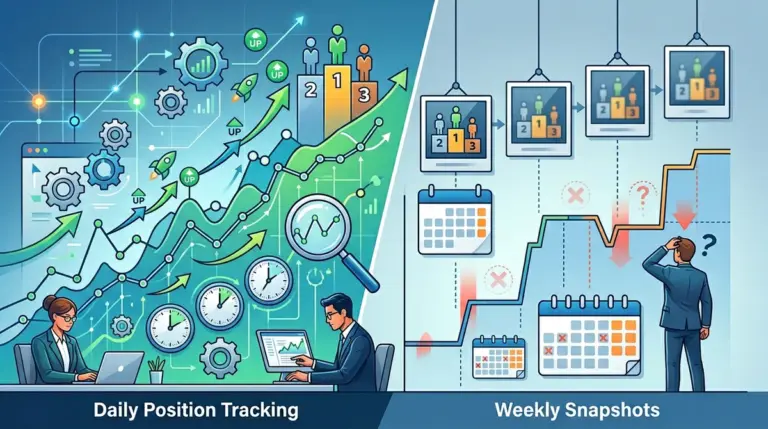
In a volatile market, data that is 24 hours old is often obsolete. High-volume keywords or those tied to trending topics require "On-Demand" or hourly refreshes. However, for long-tail keywords, daily updates are sufficient to avoid data bloat. The key is to segment your keyword buckets by volatility.
API Integration vs. Dashboard Manual Checks
For agencies managing thousands of keywords, manual dashboard monitoring is inefficient. The most accurate way to handle data at scale is through a direct API feed into a custom data warehouse (like BigQuery or Snowflake). This allows you to cross-reference keyword positions with actual GSC click data and conversion metrics in real-time. By doing this, you can identify "phantom drops"—where a rank appears to fall but traffic remains steady due to a change in SERP layout rather than a loss of visibility.
Handling SERP Feature Volatility
SERP features like "People Also Ask," "Video Carousels," and "Featured Snippets" are now standard. An accurate tracker must report on "Feature Ownership." If you own the Featured Snippet, your "Position 1" is vastly more valuable than a standard Position 1. Conversely, if a competitor owns the snippet, your Position 2 is significantly devalued. Your reporting should weight your "Share of Voice" based on which features you occupy, rather than just an average of your numerical rankings.
Calculating Competitive Share of Voice (SOV)
Individual keyword tracking can lead to "missing the forest for the trees." In 2026, the most successful SEOs track Share of Voice across entire categories. SOV is calculated by taking the total search volume of a keyword set and weighting it by the estimated CTR of your current positions across that set.
Best for: Quarterly board reporting and high-level strategy shifts.
If your average position improves from 12 to 8, but your SOV drops because your competitors took over the "Images" and "Shopping" blocks for your highest-volume terms, your strategy is failing despite the "positive" rank movement. Accuracy means reporting on the commercial reality, not just the technical position.
Executing a Modern Tracking Audit
To ensure your tracking remains accurate through 2026, perform a quarterly audit of your keyword list. Remove "vanity" terms that have zero search volume or are dominated by unmovable brand-specific AI responses. Replace them with "Intent Clusters"—groups of keywords that represent a specific stage of the buyer journey.
Ensure that every tracked keyword is assigned a "Target SERP Feature." If you are targeting a local "Service" keyword, your tracker should be looking specifically for Map Pack presence. If you are targeting a "How-to" keyword, it should be looking for Video or Featured Snippet presence. When the tool reports a change, you will know exactly which feature was gained or lost, allowing for immediate content optimization.
Frequently Asked Questions
How often should I refresh my keyword data for the best accuracy?
For high-competition, high-volume keywords (head terms), daily or hourly refreshes are necessary to capture SERP volatility. For long-tail keywords or low-competition niches, a weekly refresh is usually sufficient to identify trends without overspending on crawl credits.
Why does my rank tracker show a different result than my manual search?
Manual searches are heavily influenced by your personal search history, browser cookies, and hardware-level location data. Professional rank trackers use clean-room environments and residential proxies to simulate a "neutral" user, which provides a more objective and repeatable data point than a manual check.
Should I track mobile and desktop rankings separately in 2026?
Yes. Search engines use different indexing and ranking algorithms for mobile and desktop. Furthermore, the SERP layouts differ significantly; a mobile search is more likely to show local results and shorter AI summaries, while desktop may show more extensive sidebars and shopping grids. Tracking both is essential for a complete visibility map.
What is the most important metric to track besides position?
Pixel Depth or "Above the Fold" percentage is the most critical metric in 2026. Knowing you are in position 3 is useless if position 3 is located 1,200 pixels down the page, requiring multiple swipes to reach. Tracking where your result actually appears on the screen provides a more accurate prediction of traffic than numerical rank alone.