

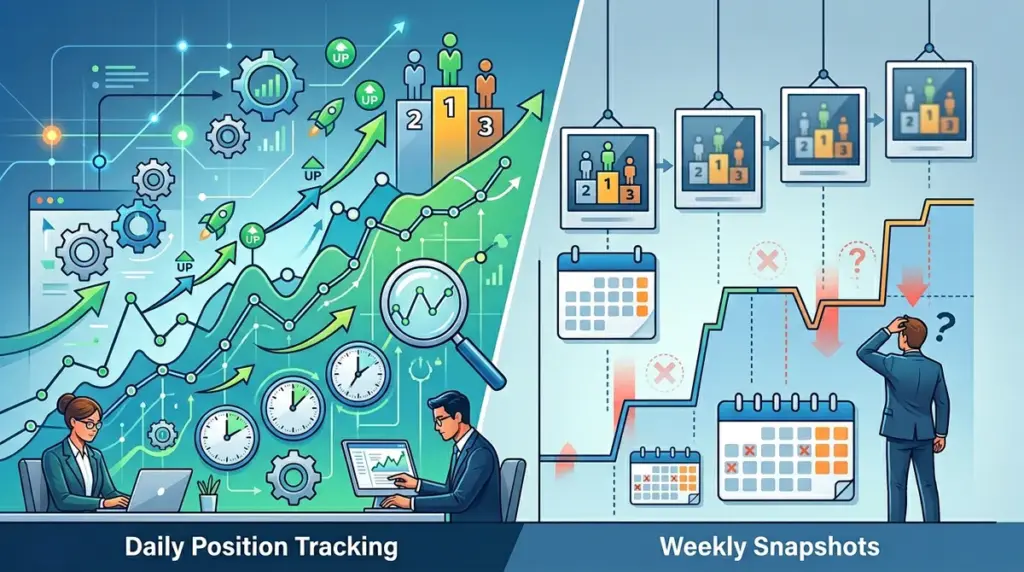
SEO professionals often treat rank tracking as a passive reporting task rather than an active diagnostic tool. When you rely on weekly snapshots, you are essentially looking at a rearview mirror that only updates every few miles. In a search environment defined by continuous algorithm refreshes and aggressive competitor maneuvers, a seven-day gap in data is a blind spot that can cost thousands in lost organic revenue. Daily position tracking is not about obsessing over minor fluctuations; it is about capturing the granular data required to make informed technical and strategic pivots before a trend becomes a crisis.
The Hidden Cost of Data Latency
The primary argument for weekly tracking is usually cost or the desire to avoid "noise." However, this overlooks the financial reality of search volatility. If a high-converting keyword drops from position 2 to position 12 on a Monday, and your tracker doesn't update until the following Sunday, you have spent six days flying blind. During that interval, you are losing traffic, conversions, and market share without even knowing a problem exists.
Best for: E-commerce sites and lead-gen publishers where daily fluctuations correlate directly to daily revenue targets.
Daily tracking allows for immediate triage. When a drop occurs, daily data helps you determine if the shift was a site-wide technical failure, a specific URL issue, or a broader algorithm update. Weekly data smooths these movements into a single data point, making it impossible to pin down the exact moment the decline began. Without that timestamp, correlating the drop with internal site changes or external market shifts becomes guesswork.
Detecting Keyword Cannibalization and Indexing Flips
Keyword cannibalization—where two or more pages on your site compete for the same query—is often invisible in weekly reports. You might see a stable ranking of position 5 every Sunday, but daily tracking might reveal that Page A ranks on Monday, Page B ranks on Tuesday, and they continue to flip-flop throughout the week. This "flicker" is a clear signal to Google that it is unsure which page is the most authoritative.
Identifying URL Instability
When Google alternates between two URLs for a single keyword, it often suppresses both over time. Daily tracking highlights this instability immediately. You can see the specific days the URL changed, allowing you to check your internal linking or canonical tags from those specific dates. A weekly snapshot would likely only catch one of those URLs, leading you to believe the ranking is stable when it is actually under threat.
Monitoring Technical Deployments
For dev-heavy environments, daily tracking is a vital QA layer. If a deployment on Tuesday accidentally strips meta titles or breaks a schema markup, you will see the impact on Wednesday or Thursday. If you are on a weekly cycle, that technical error could persist for nearly a week before it even registers on your dashboard. By then, the damage to your crawl budget and trust signals may take weeks to reverse.
Pro Tip: Use daily tracking to monitor "SERP features" like Featured Snippets and People Also Ask boxes. These elements are highly volatile. If you lose a snippet on Tuesday, you can analyze the new winner's content immediately and adjust your headers to win it back by Thursday. Waiting until Sunday gives your competitor a week to solidify their hold on that zero-click real estate.
Navigating Algorithm Volatility and Core Updates
Google no longer releases one or two major updates a year. We now see a constant stream of core updates, helpful content system refreshes, and spam updates that can roll out over several weeks. Daily tracking is the only way to map the trajectory of these updates accurately.
- Trend Analysis: Daily data shows whether a decline is a sharp "cliff" (likely a manual action or major technical break) or a gradual "slide" (likely a loss of relevance or a competitor's gain).
- Recovery Verification: After making optimizations to recover from an update, daily tracking provides the fast feedback loop needed to see if those changes are moving the needle.
- Competitor Movement: Daily updates let you see if a competitor is surging across an entire category simultaneously, indicating they have likely made a systemic site change or benefited from a specific update.
Without this frequency, you cannot distinguish between a temporary "Google Dance" and a permanent shift in the search landscape. High-frequency data allows you to stay calm during minor tremors and act decisively during major shifts.
Agency Accountability and Client Management
For agencies, daily tracking is a defensive necessity. Clients often monitor their own high-value keywords manually. If a client sees a drop on a Wednesday and calls their account manager, the agency must have the data to explain it. An agency relying on weekly reports will be forced to admit they haven't seen the data yet, which undermines their perceived expertise and responsiveness.
Daily tracking allows agencies to be proactive. Instead of reacting to a client's concern, the agency can send a note on Thursday saying, "We noticed a shift in the SERP landscape yesterday and are already analyzing the competitor who took the top spot." This shifts the narrative from reactive reporting to proactive strategy.
Optimizing the Signal-to-Noise Ratio
The most common critique of daily tracking is that it provides too much "noise"—minor rank changes that don't matter. The solution is not to reduce data frequency, but to improve data filtering. Effective SEOs use daily tracking to look for patterns, not individual movements. A one-position move is noise; a three-day downward trend across an entire keyword cluster is a signal.
By maintaining a daily record, you build a high-resolution historical database. When you conduct a quarterly review, that daily data allows for much more sophisticated trend lines and volatility scoring than a mere 12 or 13 weekly data points could ever provide.
Transitioning to a High-Frequency Tracking Strategy
To move from reactive snapshots to proactive daily monitoring, you must adjust your workflow. Start by segmenting your keywords. While every keyword benefits from daily tracking, prioritize your "Money Keywords" and "Striking Distance" keywords for immediate daily review. Set up automated alerts for any significant movement (e.g., +/- 5 positions) so you don't have to manually check the dashboard every morning.
Integrate your rank tracking with other daily metrics like organic sessions in GA4 or Search Console clicks. When you see a dip in clicks, you can immediately cross-reference it with your daily position data to see if a specific rank drop was the cause. This level of integration turns rank tracking from a vanity metric into a core component of your business intelligence stack.
Frequently Asked Questions
Does daily tracking cause more stress than weekly tracking?
Only if you react to every single movement. The goal of daily tracking is to provide a more accurate trend line and faster diagnostic data for when things go wrong. Once you learn to distinguish between daily SERP "jitter" and a sustained trend, daily data actually reduces stress by removing the uncertainty of what happened between weekly reports.
Will daily tracking impact my site's performance or crawl budget?
No. Professional rank tracking tools use their own infrastructure to check Google's search results. They do not "crawl" your site in a way that consumes your server resources or affects your Googlebot crawl budget. It is a completely external observation of the SERPs.
Is daily tracking necessary for low-volume keywords?
While the immediate financial impact of a low-volume keyword dropping might be small, these keywords often act as "canaries in the coal mine." If you see a cluster of low-volume long-tail keywords all dropping on the same day, it can be an early warning sign of a larger issue affecting your site's overall authority before your high-volume head terms are impacted.
How do I explain daily volatility to a non-technical client?
Explain that search results are a live marketplace. Just as stock prices fluctuate throughout the day based on trading volume, search positions fluctuate based on user behavior and algorithm testing. Emphasize that you use the daily data to catch major shifts early, while still focusing on the 30-day trend for overall performance evaluation.